
October 12, 2026 | Buying
Downsizing From a Longtime Family Home: How to Plan the Move Without Rushing the Decision
For homeowners who have lived in the same house for 30 or 40 years, downsizing can sound simple in theory: sell the family home, purchase something smaller and move on to the next stage of life.
In practice, the decision is rarely that tidy.
A longtime home can hold decades of memories. There may be years of belongings to sort through, uncertainty about what comes next, and a surprisingly complex real estate question underneath it all: should you sell first or buy first?
After more than 16 years in residential real estate, Luke O’Reilly, Real Estate Broker with The O’Reilly Group at Royal LePage State Realty, has learned that there is no standard timeline.
‘Everybody’s journey is a little bit different,’ O’Reilly says. ‘Some people are extremely well prepared and have been thinking about and planning for the downsizing process long before they’ve even called us in. Other people, the process will take months to years before they actually make the move.’
For homeowners considering downsizing in Hamilton and the surrounding area, that may be the most useful place to begin: you don’t need to know exactly when you’re moving to start planning for it.
The short answer: Where should you start when downsizing?
Start by understanding three things: what your current home may realistically sell for, what needs to be done to prepare it for market, and what you would actually want from your next home.
From there, homeowners can begin decluttering gradually, watch or tour potential properties, assess their financial position and eventually determine whether selling first or buying first makes more sense.
The process doesn’t need to begin with a For Sale sign.
Downsizing is rarely one big decision
One of the misconceptions surrounding downsizing is that homeowners suddenly decide one morning that it’s time to move.
O’Reilly‘s experience has been considerably more varied.
He recalls meeting one future client at an open house at Garth Trails in Hamilton. The homeowner knew the type of community they wanted and, once the right opportunity emerged, things moved quickly.
Within a matter of months, they purchased another property in the same complex. Their existing home was prepared for market in roughly two weeks.
‘They were quite driven and focused on a goal,’ O’Reilly says. ‘Even their friends were quite shocked that they moved so quickly on it.’
At the opposite end are homeowners O’Reilly has worked with over several years as they gradually move closer to making a decision.
Neither approach is inherently better.
‘There’s not one set approach,’ he says. ‘Everybody’s journey is different and everybody’s timeline is different. We’re really working on our client’s timeline.’
For someone who isn’t sure they’re ready, that can change the nature of the first conversation. Instead of deciding whether to sell, the objective becomes figuring out what would need to happen if they eventually decide to sell.
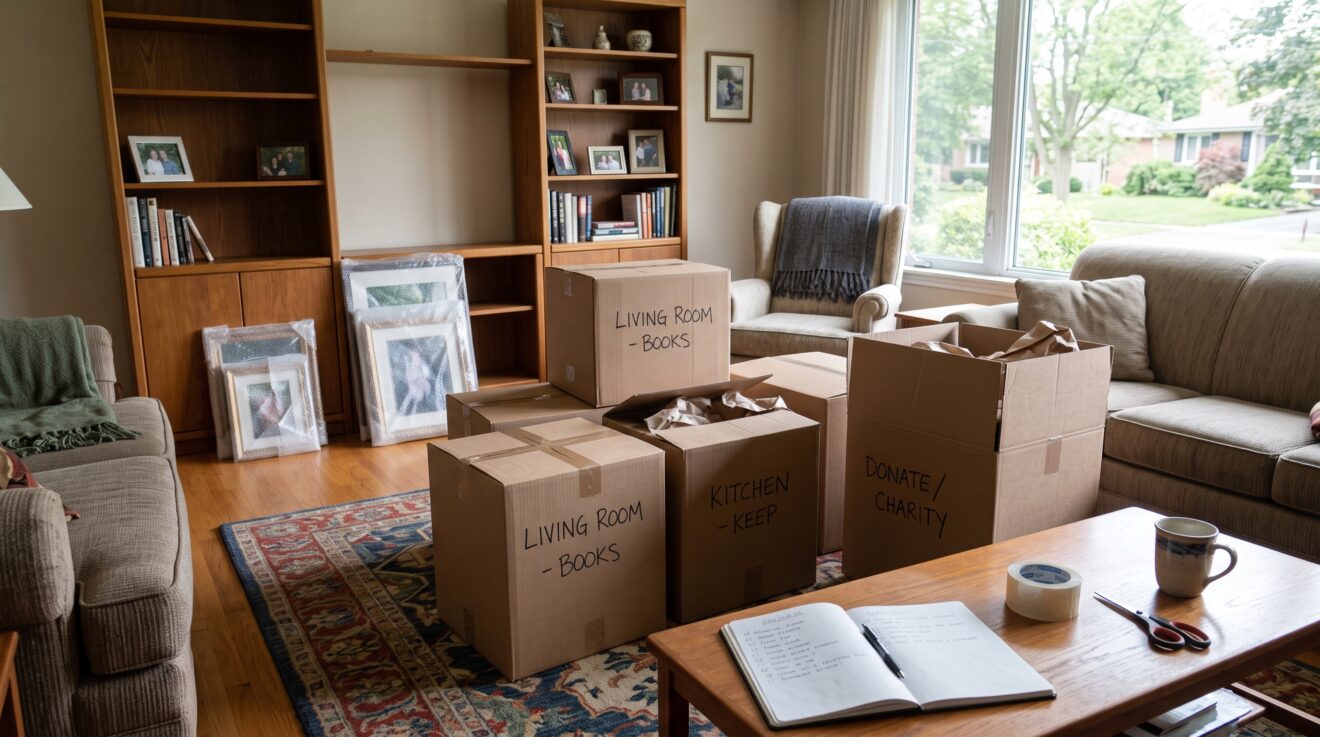
A good downsizing plan often begins inside the current home
For many longtime homeowners, the sheer amount of work associated with moving becomes one of the reasons to postpone it.
Rooms need to be sorted. Furniture needs to be dealt with. Closets, basements and garages can contain decades of belongings. Then there are questions about repairs, painting, staging and whether larger improvements are worthwhile before selling.
O’Reilly recommends creating a plan before trying to solve everything at once.
‘Having a member of our team come through your property and provide advice on how to best prepare your home for sale can be a really good starting point,’ he says. ‘It can provide a roadmap and a checklist for sellers to start that process.’
That roadmap can also help separate work that is likely worthwhile from projects that may be unnecessary.
For the physical decluttering itself, his advice is deliberately straightforward.
‘Attack one room at a time. Come up with a list and prioritize that list.’
Some homeowners will be comfortable doing that independently. Others may need additional help. O’Reilly‘s team has worked with decluttering companies and a professional stager, allowing clients to bring in support where it makes sense.
‘Through a variety of our team members, we’re able to give our clients a clear path forward so that the overwhelm can subside and they have a plan to follow.’
The objective isn’t necessarily to get the house ready quickly. It’s to replace a vague, intimidating project with a sequence of manageable steps.
____________________________________________________________________________
Other helpful blogs:
- How Much Does It Cost to Sell a Home in Ancaster, Dundas and Hamilton?
- What Happens When You Receive an Offer on Your Home? A Seller’s Guide for Ancaster, Dundas, Hamilton & Burlington
____________________________________________________________________________
The other half of the plan is figuring out what comes next
Preparing the existing house without exploring the next one can leave an important question unanswered:
What would you actually be willing to leave this home for?
O’Reilly recommends developing a general wish list early in the process and beginning to watch the market.
For one homeowner, the next property might be a condominium. For another, it could be a bungalow or bungaloft. Someone else may want less maintenance without giving up private outdoor space.
Those preferences often become clearer once homeowners start seeing actual properties rather than discussing hypothetical ones.
‘I think getting out and looking at properties is an important part of the process,’ O’Reilly says. ‘It helps increase market knowledge for people who have not bought or sold in quite a long time so they can understand value. It’ll also help them better identify a great deal when something comes up.’
Touring homes can serve another purpose: it tests whether the idea of downsizing feels as appealing in reality as it does on paper.
And when the right property does appear, O’Reilly believes the reaction is often surprisingly intuitive.
‘A lot of the time, buying a home has to do with the overall experience that buyer has when they walk through the front door,’ he says. ‘I think somebody intuitively will know whether or not it’s a space that works for them.’
His advice to clients who are uncertain about a particular property is equally simple:
‘If it’s not a 100% yes, then it’s not the right fit. There’s always going to be another opportunity.’
____________________________________________________________________________
Other blogs we’ve written on downsizing below!:
- Downsizing in Hamilton: Why the Right Next Home Starts With the Life You Want to Live
- Why Should You Downsize To A Condo In Ancaster?
- What Are The Best Condos in Dundas When Downsizing?
____________________________________________________________________________
Why leaving the family home can be harder than expected
For some downsizers, the obstacle isn’t finding a smaller property.
It’s finding one compelling enough to leave the home they already love.
O’Reilly recalls working recently with a widowed homeowner who had raised her children in her longtime family home. The property itself was exceptional, but so was its setting – something that was particularly important to her.
Replicating that environment elsewhere wasn’t easy.
‘It can be a combination of letting go of the memories and the fear of the unknown,’ O’Reilly says. ‘Environment is really important to this particular seller, and I don’t blame her because her setting is extremely beautiful.’
The example illustrates why downsizing based solely on square footage can miss the point.
A home represents a collection of things that may be difficult to reproduce: familiarity, privacy, gardens, neighbours, views, a favourite room or simply the feeling someone gets when they come home.
That can make hesitation entirely rational.
O’Reilly sees his role in those situations as advisory rather than persuasive.
‘We want our client to feel in the driver’s seat because they are ultimately steering the ship,’ he says. ‘We’re here to support and advise throughout the process. We’ll make recommendations, give our opinion and use our experience from helping other people through the same process, but we really tailor each approach to the individual client.’
Should you sell your home first or buy your next home first?
Eventually, a homeowner who decides to move reaches one of the most consequential decisions in the downsizing process.
Sell first, then buy?
Or buy first, then sell?
There is no universal answer because the appropriate strategy depends on the homeowner’s financial capacity, risk tolerance, the marketability of the existing property and the availability of a backup living arrangement.
‘Some people are in a position where they can purchase another property and carry their new home as well as their previous home if they’re not quite ready to list, or if it takes a while to sell,’ O’Reilly explains. ‘That’s a really positive position for somebody to be in, but not everybody has that financial capability – or the risk tolerance, for that matter.’
For homeowners who don’t want the uncertainty of owning two properties, selling first can provide an important piece of information: exactly what they’re walking away with financially.
That has been the more common approach among O’Reilly‘s downsizing clients recently.
‘Most of my sellers this year have sold their homes first and then gone house shopping,’ he says. ‘I think that’s because the market is generally softer than previous markets right now, and most of my clients are being more conservative with their decisions. They would rather sell, know exactly what they’re walking away with at the end of the day, and then go house shopping.’
That observation is consistent with the broader risk-management principle emphasized by Ontario’s real estate regulator. RECO advises buyers and sellers to think ahead about whether closing dates align and to have a contingency plan if they don’t. RECO also notes that conditions involving financing, inspection or the sale of an existing home can provide buyers with additional protection when appropriate. Real Estate Council of Ontario
The precise strategy, however, depends on the individual transaction and the terms negotiated.
Selling first solves one problem – but creates another
Knowing exactly what your current home sold for can reduce financial uncertainty.
It doesn’t eliminate housing uncertainty.
‘The occasional seller will be concerned because there’s always the risk that they sell their home and they’re not going to find something they’re truly happy with,’ O’Reilly says. ‘That is a risk.’
This is where the backup plan becomes important.
Some homeowners negotiate a longer closing period on their sale to give themselves more time. Others have family they can stay with temporarily. Some are comfortable renting while waiting for the right property.
‘If they have somewhere they can go temporarily, or if they’re open to even renting for a period of time, they can take their time with their search and have money in the bank,’ O’Reilly says.
For a homeowner unwilling or unable to move twice, that strategy may be less attractive. But for someone whose highest priority is avoiding pressure on the next purchase, temporary accommodation can create valuable flexibility.
Buying first requires a different question: What happens if your house doesn’t sell?
Buying the next property first solves the housing problem. The homeowner knows where they’re going.
But it introduces financial risk.
O’Reilly has seen that risk become very real.
He recalls a client who purchased another property before selling their existing home. The risks had been discussed, but when the new home’s closing date arrived, the existing property still hadn’t sold and the client wasn’t in a sufficiently strong financial position to comfortably carry both.
The experience reinforced the importance of planning around more than the expected outcome.
‘If their home hasn’t sold by the time their purchase is closing, they still have to close on that purchase whether or not their house is sold,’ O’Reilly says. ‘That reinforced for me the importance of highlighting the risks before clients enter into a situation like that, so they fully understand what the repercussions are.’
In other words, the question shouldn’t simply be:
How quickly do we think this home will sell?
It should also be:
What happens if it doesn’t?
Some homes are easier to sell than others
That distinction becomes particularly important when deciding whether buying first is an acceptable risk.
O’Reilly evaluates how quickly comparable properties are turning over in the immediate area, whether the homeowner is prepared to price appropriately and how broad the likely buyer pool is.
‘If a home is overly quirky or too niche – and especially if it’s not priced right – those homes are not selling,’ he says. ‘When I’m talking about a highly saleable property, I really focus on how quick the turnover is in the immediate area and assess how wide of a demographic there is for that particular property.’
A conventional home that appeals to many buyers may present a different risk profile from a highly customized property that requires a very particular purchaser.
Price can alter that assessment too.
‘If the home appeals to a wide demographic, there’s going to be more buyers potentially interested in that property, as opposed to a property that’s niche where there’s only a handful of buyers for it,’ O’Reilly says. ‘I think it’s important to weigh all of that out before making any decisions on whether you buy or sell first.’
This is professional judgment rather than a guarantee. Even a property that appears highly marketable can take longer than expected to sell.
When the purchase and sale collide
Perhaps the most instructive example from O’Reilly‘s recent downsizing work involved homeowners who had lived in the same Ancaster house for more than 40 years.
They weren’t looking for just any smaller property. They wanted a particular style of bungaloft townhome.
Eventually, they found one they were happy with.
O’Reilly negotiated an agreement to purchase the townhome that was conditional upon the sale of their existing property, with several weeks provided to get the Ancaster home sold.
On its face, the strategy appeared straightforward.
But conditional transactions can interact in ways homeowners may not anticipate.
Depending on the terms of an agreement, a seller may retain the ability to consider another offer while the first buyer is still relying on a sale-of-property condition. If the contractual mechanism is triggered, that buyer may face a limited period to decide whether to remove their condition and proceed or allow the other transaction to move forward.
Now add another conditional transaction.
Imagine the downsizers’ Ancaster home has received an offer, but that buyer still has several days to satisfy financing and inspection conditions. During that period, the seller of the bungaloft accepts another offer and triggers the mechanism in the original purchase agreement.
The downsizers can suddenly face two very different risks.
Firm up on the bungaloft, and the buyer of their Ancaster home could subsequently fail to satisfy a condition, leaving the downsizers committed to a purchase while their existing property remains unsold.
Walk away from the bungaloft, and their own buyer could subsequently firm up, leaving them with a sold family home but without the property they intended to move into.
‘If I was an agent that didn’t have the proper experience, my clients could have ended up in a really terrible situation,’ O’Reilly says.
In that transaction, O’Reilly says the clients’ sale agreement was structured with an additional condition designed to provide protection if the two transactions collided in that way.
The lesson for homeowners isn’t to request a particular clause – contractual language and its legal implications depend on the individual transaction and should be reviewed with the appropriate real estate and legal professionals.
The lesson is that buying and selling at the same time should be treated as one interconnected strategy.
____________________________________________________________________________
Suggested Reading on Neighborhood Choices for Empty-Nesters:
____________________________________________________________________________
Ontario’s regulator similarly encourages buyers to understand what they’re signing, consider appropriate conditions and obtain independent legal advice where desired. It also cautions buyers against casually removing protective conditions simply because circumstances become competitive. Real Estate Council of Ontario
For O’Reilly, the Ancaster transaction illustrates why experience with downsizing is about more than identifying a suitable bungalow or preparing a house for market.
‘You have to understand how all of these pieces interact,’ he says. ‘It’s about highlighting the potential scenarios before your client enters into them so they can make an informed decision.’
A practical way to start downsizing – before you’re ready to move
For a homeowner who has been thinking about downsizing but feels overwhelmed by the size of the decision, the first steps can be relatively small.
Get an accurate assessment of the existing home. Develop a preparation and decluttering plan. Begin defining the criteria for the next property. Watch listings and tour homes to understand what different price points actually offer. Speak with financial, legal and other appropriate professionals where necessary. And, before buying or selling, understand what happens if the transaction doesn’t unfold exactly as expected.
Most importantly, don’t confuse planning with committing.
A homeowner can spend months becoming better informed and ultimately decide that the family home is still the right place to be.
For O’Reilly, that’s not a failed downsizing conversation.
It’s clarity.
‘There’s always zero pressure from us,’ he says. ‘Everybody’s journey is different. We’re working on our client’s timeline.’
For someone contemplating leaving a home that has been part of their life for decades, knowing the next step may matter far more than knowing the moving date.
FAQ
How far in advance should you start planning to downsize?
There is no required timeline. Some homeowners can prepare and move within weeks, while others plan over months or years. Starting early can provide time to understand your home’s value, declutter gradually, explore potential properties and determine whether the financial and lifestyle trade-offs make sense before committing to a sale.
Should you sell your current home before buying a smaller one?
It depends on your financial position, risk tolerance, local market conditions, the marketability of your existing property and whether you have a temporary housing option. Selling first provides certainty about your sale proceeds, while buying first can provide certainty about where you’re moving but may expose you to the risk of carrying two properties.
What happens if I sell my house and can’t find another home?
This possibility should be considered before listing. Depending on your circumstances, options may include negotiating a longer closing date, staying temporarily with family or arranging rental accommodation while continuing your search. RECO recommends having a contingency plan when sale and purchase closing dates may not align. Real Estate Council of Ontario
Can I make an offer conditional on selling my existing home?
An offer can potentially include a condition related to the sale of an existing property, depending on the circumstances and what the parties negotiate. RECO identifies the sale of an existing home as one example of a condition that may provide a buyer with additional protection. The wording, timelines and implications should be carefully understood before signing. Real Estate Council of Ontario
How should I start decluttering after living in a home for decades?
Start with one room rather than trying to tackle the entire house. Create a prioritized list and work through it gradually. Homeowners who find the process overwhelming can also consider professional decluttering, moving and staging assistance.
How do I know what type of home I should downsize into?
Begin with lifestyle rather than square footage. Consider maintenance, stairs, accessibility, outdoor space, parking, location, proximity to amenities, storage and how long the property is likely to suit your needs. Touring different property types before you’re ready to purchase can help clarify which trade-offs actually matter to you.
Is downsizing always financially beneficial?
No. A smaller property isn’t automatically less expensive overall. Purchase price is only one consideration; condominium fees, taxes, moving and transaction costs, maintenance, renovations and other expenses may affect the financial outcome. Homeowners should evaluate the complete picture with the appropriate financial, tax, legal and real estate professionals.

We're On Your Side
Whether you’re selling or buying the O’Reilly Group is dedicated to elevating your real estate experience.