October 9, 2026 | Community: Ancaster
How We Sold a Luxury Home in Ancaster in 10 Days: What Sellers Can Learn From the Strategy
Selling a luxury home in Ancaster in a softer real estate market is still possible. But when there are fewer buyers at the upper end of the market, there is less room for error in how a property is prepared, priced and marketed.
That was the challenge behind the June 2026 sale of an exceptional custom residence in Ancaster’s Oakhill neighbourhood, close to Jerseyville Road West and Lovers Lane.
The home came to market at $3,699,900. Ten days later, it was sold.
For Luke O’Reilly, Real Estate Broker with The O’Reilly Group at Royal LePage State Realty, the sale reinforced something he has observed repeatedly throughout his career: successful outcomes rarely come down to one decision.
In this case, three parts of the strategy had to work together – preparation, pricing and marketing.
‘When I look back at this sale, I don’t think there was one thing that sold the property,’ says O’Reilly. ‘It was the combination of properly preparing the home, executing a strong marketing plan and having a well-thought-through pricing strategy. Those three elements all had to work together.’
For luxury homeowners in Ancaster wondering whether they need to wait for a significantly different market before making a move, the transaction provides a useful real-world case study.
What Does It Take to Sell a Luxury Home in a Softer Market?
A softer luxury market doesn’t mean good properties can’t sell. It does mean sellers need to be more deliberate about how their home enters the market.
In this case, the strategy started well before the listing went live. The property was carefully prepared and professionally staged, the pricing was considered in the context of the market buyers were actually responding to, and the marketing was designed to reach prospective purchasers beyond traditional listing channels.
The eventual purchaser discovered the home through social media despite not previously following O’Reilly.
The result was a sale in 10 days.
But the work behind that outcome began almost two years earlier.
____________________________________________________________________________
Other related blogs that will provide even further insight in the luxury space:
- What a Certified Luxury Home Marketing Specialist Really Means for Luxury Home Sellers in Hamilton, Ancaster, Dundas, and Burlington
- How to Buy a Luxury Home that Holds its Value in Hamilton, Ancaster & Dundas
- How to Sell a Luxury Home in Ancaster
____________________________________________________________________________
The Strategy Started Long Before the Home Was Listed
Conversations about eventually selling this particular home began approximately two years before it came to market.
That lead time created an opportunity to do something O’Reilly believes can be valuable for sellers who know a move may be on the horizon: understand the market before having to make decisions within it.
‘We were regularly sending them noteworthy sales over about $2.5 million in the general area,’ O’Reilly says. ‘The idea was to keep them informed so they could keep their finger on the pulse of the luxury market – what was selling, where values appeared to be and how much activity we were actually seeing.’
Toward the end of 2025, the conversation became more concrete. The owners indicated that they were serious about selling in 2026.
At that point, market monitoring began turning into a specific plan for the property.
Preparing the Home Through the Eyes of a Prospective Buyer
The home already had attributes that distinguished it within Ancaster‘s luxury market.
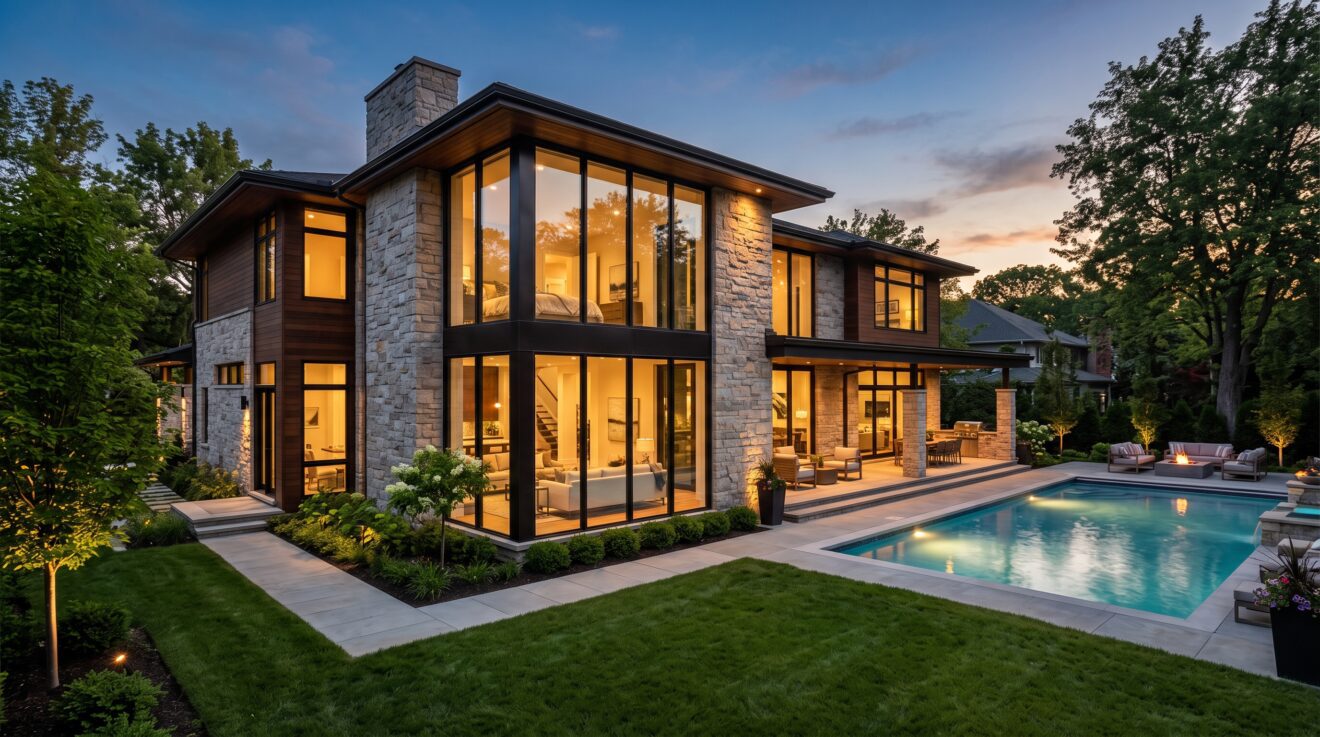
The custom residence was designed by internationally recognized architect John Williams, with more recent design enhancements by Lauren Kyle McDavid of Kyle & Co. It offered 5+1 bedrooms, five bathrooms, a triple-car garage, an extensively finished lower level and significant outdoor living and entertaining spaces centred around an in-ground pool.
But having an impressive property didn’t eliminate the need to prepare it carefully.
O’Reilly began with a comprehensive walkthrough of the interior and exterior, looking specifically for touch-ups and other opportunities that could strengthen the impression the home would make on prospective buyers.
‘My approach was to walk through the property the way a prospective buyer was going to walk through it,’ he says. ‘The objective wasn’t to renovate the house unnecessarily. It was to identify the touch-ups and recommendations that could help us make the best possible impression when buyers eventually came through the door.’
The sellers were receptive to the recommendations, and their tradespeople completed a number of the items.
O’Reilly then returned to the property to review the progress.
And then returned again.
‘It wasn’t a case of doing one walkthrough, handing over a list and coming back on photography day,’ he says. ‘I went back a number of times as things progressed. We’d look at what had been completed, I’d make further recommendations where appropriate, and we kept working toward getting the property into the best possible showing condition.’
For sellers, there’s an important lesson in that process.
Preparing a luxury home for sale doesn’t necessarily mean undertaking major renovations or spending money everywhere possible. The more useful question is which improvements are likely to meaningfully affect the way prospective buyers experience the property.
The Exterior Was Part of the Experience
The preparation extended beyond the interior of the home.
Landscaping enhancements were completed so the grounds were showing well. The pool was opened and prepared so buyers visiting the property could experience the outdoor spaces as they were intended to be enjoyed.
That mattered because the outdoor environment was an important part of the home’s appeal.
‘With a property like this, buyers aren’t just evaluating the kitchen or the primary bedroom,’ O’Reilly says. ‘They’re taking in the entire property. We wanted the landscaping showing well, we wanted the pool open and in great condition, and we wanted somebody arriving for a showing to experience the whole property properly.’
It’s a useful distinction for luxury sellers.
The first impression isn’t created when a buyer reaches the kitchen.
It begins when they arrive.
Being the Sellers’ ‘Boots on the Ground’
There was also a practical consideration during the preparation process: the sellers were regularly out of town.
That meant O’Reilly‘s role extended beyond making recommendations.
‘I really became their boots on the ground,’ he says. ‘If a tradesperson needed access, I could help facilitate that. I could meet people at the property when necessary, go back through the home, see how things were progressing and help keep everything moving while the sellers were away.’
It’s a part of the listing process that prospective sellers don’t necessarily see in the finished photography.
Preparing a significant property can involve coordinating trades, landscaping, staging, photography, videography and numerous smaller details. Even when a homeowner agrees with the strategy, executing it can become a substantial undertaking.
For O’Reilly, there is a difference between recommending a plan and helping a seller carry it out.
‘Part of my role was making the process easier for them,’ he says. ‘If I’m making recommendations about what I think we should do before listing, I also want to help make sure those things actually get accomplished and that the process keeps moving.’
Why Professional Staging Mattered
Once the physical preparation was underway, O’Reilly brought in the team’s lead stager for a comprehensive consultation and walkthrough.
She developed a staging plan specifically for the home and executed it before the property came to market.
For O’Reilly, staging a luxury property serves two audiences.
One is the person physically walking through the home.
The other is the person who hasn’t decided to book a showing yet.
‘She did an excellent job,’ he says. ‘The home showed beautifully in person, but equally important, it showed beautifully through the photography and videography.’
That distinction has become increasingly important in property marketing.
A prospective buyer’s first experience with a home may happen through MLS photography, a listing video or a piece of social media content. The presentation therefore needs to translate through a screen well enough to make someone want to take the next step.
By launch, the touch-ups were complete, the landscaping was showing well, the pool was open and in great condition, and the staging was in place.
Then came one of the most important decisions in the strategy.
____________________________________________________________________________
Need more insight on how to prepare your home? Check out the following related blogs below:
- Do Staged Homes Sell Faster?
- Common Home Inspection Issues Sellers Face and How to Get Ahead of Them Before Listing
- What to Do if Your Home isn’t Selling in Hamilton: A Step-By-Step Strategy
____________________________________________________________________________
How Do You Price a Luxury Home When Comparable Sales Are Limited?
Pricing a distinctive luxury property isn’t always straightforward.
The challenge becomes even greater when relatively few homes are trading at the upper end of the market, leaving sellers and their agents with fewer recent comparable sales to work from.
Leading into the June listing, O’Reilly had been closely monitoring the luxury segment with the sellers. Activity at the upper end of the Ancaster market had been limited, and that became an important part of the pricing conversation.
The sellers and O’Reilly discussed different possibilities, including whether the home should come to market at a higher asking price.
Ultimately, they chose $3,699,900.
‘We absolutely discussed listing the property higher,’ O’Reilly says. ‘But ultimately, we all agreed on a pricing strategy that we felt made sense based on the home itself and the market we were selling into.’
For O’Reilly, this illustrates an important distinction.
Pricing isn’t simply an exercise in estimating what a property might be worth. It’s also a strategic decision about how that property should be positioned against the alternatives buyers have at that particular moment.
‘Pricing is hugely important to the overall strategy,’ he says. ‘You have to look at the property, the relevant sales, the competition and what you’re seeing in the market, and then come up with a well-thought-through strategy for how you want to position the home.’
That approach doesn’t mean trying to be the cheapest property in a category.
Nor does it mean assuming the highest conceivable price is automatically the best starting point.
It means considering the evidence available and making a deliberate decision about where the property should enter the market.
What Happens When a Luxury Home Is Considerably Overpriced?
A familiar argument in luxury real estate is that a distinctive property only needs one buyer.
That’s true.
But that buyer still has alternatives.
And O’Reilly believes sellers can underestimate the effect that substantial overpricing can have on buyer psychology.
‘Especially in the luxury space, considerably overpricing a property can result in increasing days on market and buyers becoming hesitant,’ he says. ‘When a property sits for a long time, buyers can start wondering whether there’s something wrong with it.’
That change in perception can create a problem that didn’t necessarily exist when the home first came to market.
‘You can potentially create a stigma around a property that didn’t need to be there in the first place,’ O’Reilly says.
That doesn’t mean every luxury property should follow the same pricing formula.
Architecture, lot characteristics, condition, location, scarcity and current competition can all affect the appropriate strategy. With distinctive properties, there may also be relatively few truly comparable sales.
The point is simpler: uniqueness doesn’t make pricing irrelevant.
For this Oakhill home, the owners and O’Reilly made the pricing decision before the property launched and committed to a position they believed reflected both the quality of the home and the realities of the market.
Then the third part of the strategy produced an unexpected connection.
The Eventual Buyer Wasn’t Following O’Reilly on Social Media
Once the property launched, it generated several inquiries.
But the eventual purchaser didn’t discover the home because they were already following O’Reilly or The O’Reilly Group.
The property’s video appeared on their For You page.
‘This was somebody who wasn’t following me at the time,’ O’Reilly says. ‘The property came up on their For You page, they reached out, and that started a conversation.’
What happened next illustrates why O’Reilly sees social media as more than another place to repost listing photographs.
The exposure led to a conversation.
The conversation led to a showing.
The showing led to an offer.
And ultimately, a deal was put together between the buyer and seller.
‘That’s an important part of the story for me,’ O’Reilly says. ‘The person who ultimately purchased the property wasn’t already part of my social media audience. The marketing put the home in front of them.’
That doesn’t mean social media will produce the purchaser for every property.
But it demonstrates what broader distribution can accomplish.
For a distinctive home with a smaller potential buyer pool, the marketing strategy shouldn’t necessarily be limited to people already following the agent, searching the agent’s website or receiving a listing alert.
Sometimes the buyer finds the property.
In this case, the marketing helped the property find the buyer.
From a For You Page to a Sale in 10 Days
Ten days after the home came to market, the parties had reached an agreement.
O’Reilly represented both the seller and purchaser in the transaction under multiple representation.
While the details of the negotiation remain private, the more useful lesson for prospective sellers lies in everything that happened before the offer arrived.
By the time the eventual purchaser saw the property on social media, much of the work had already been done.
The sellers had spent months following the market.
The property had been carefully prepared.
The staging and visual presentation were complete.
The pricing strategy had been established.
And the marketing assets were in place to introduce the home to people beyond O’Reilly‘s existing audience.
The social media connection mattered.
But it was the final link in a much longer chain.
What Actually Sold This Ancaster Luxury Home?
Looking at the transaction afterward, it would be easy to attribute the result to the social media video that reached the eventual purchaser.
O’Reilly doesn’t see it that way.
‘The biggest lesson for me is that proper preparation, strong marketing and a well-thought-through pricing strategy all work together,’ he says. ‘I wouldn’t look at any one of those things in isolation.’
Preparation shaped the buyer’s experience
The process began before launch with multiple walkthroughs and targeted touch-ups.
The landscaping was enhanced. The pool was opened and showing well. Professional staging helped the property present effectively both in person and through photography and video.
The objective wasn’t to make unnecessary changes.
It was to make sure the home made the strongest possible impression when buyers finally encountered it.
Pricing established the property’s position
The sellers considered different pricing possibilities, including coming to market higher.
Instead of treating the asking price as an isolated number, they considered the home itself, relevant sales, available competition and the conditions in the luxury market.
The result was a deliberate pricing strategy at $3,699,900.
Marketing expanded the potential audience
Professional presentation created the material for the campaign.
Distribution then put that material in front of prospective buyers – including someone who wasn’t already following O’Reilly.
That person ultimately purchased the home.
Preparation strengthened the product buyers experienced.
Pricing determined how the property entered the market.
Marketing expanded who saw it.
The outcome came from the relationship between all three.
Does a Softer Luxury Market Mean Nothing Is Selling?
One misconception O’Reilly encounters is the idea that when the broader market becomes slower, there is effectively no movement in luxury real estate.
He thinks that conclusion is too broad.
‘I think there’s a misconception that there’s no movement in the luxury space,’ he says. ‘If it’s a great product and there’s a proper strategy around the overall presentation, this is an example of how a well-executed plan can result in a sale coming together in a timely fashion.’
One successful transaction doesn’t establish what will happen with the next property.
Nor should a 10-day sale be interpreted as a promise of what another luxury seller should expect.
What the transaction demonstrates is more measured: a softer market and a successful sale aren’t mutually exclusive.
But when buyers have more choice and transactions are less frequent, the details of the strategy become more consequential.
Presentation matters.
Pricing matters.
Distribution matters.
And each one affects the others.
Should Ancaster Luxury Sellers Wait for the Market to Improve?
For some homeowners, waiting may make sense.
But O’Reilly doesn’t believe the decision should be based solely on the perception that today’s market is softer than it was several years ago.
He sees homeowners who have legitimate reasons to move but remain in a wait-and-see pattern because they aren’t sure whether a successful sale is realistic.
‘There are definitely sellers who are sitting on the sidelines and monitoring what happens,’ he says. ‘What I would want them to know is that if they have specific plans, there can still be a clear path forward.’
Finding that path doesn’t require predicting exactly what the market will do next.
It requires understanding the individual property and the seller’s objectives.
How would the home compare with the competition available today? What preparation would meaningfully improve its presentation? What do the most relevant recent sales tell us? How should the property be positioned? And what will the marketing strategy actually do to reach prospective buyers?
Those questions can be evaluated now.
‘If somebody has a reason to move, I think the starting point is sitting down with an experienced agent and developing the right plan for that particular property,’ O’Reilly says. ‘Sometimes the conclusion might still be to wait. But a softer market doesn’t automatically mean you can’t move forward.’
That may be the most useful lesson from this Oakhill sale.
The home didn’t sell because market conditions suddenly became perfect.
It sold after an extended period of market monitoring, thoughtful preparation, repeated walkthroughs, strategic touch-ups, landscaping enhancements, professional staging, a carefully considered pricing decision and a marketing campaign that ultimately reached the eventual purchaser.
A softer market doesn’t eliminate opportunity. It increases the importance of having a well-thought-through strategy.
And for a luxury homeowner considering a sale, the better question may not be:
When will the market be perfect?
It may be:
What would the right strategy look like for my property in the market we have today?
About Luke O’Reilly
Luke O’Reilly is a Real Estate Broker with The O’Reilly Group at Royal LePage State Realty. A second-generation Realtor with more than 16 years of residential real estate experience, Luke works with buyers and sellers throughout Ancaster, Hamilton, Dundas and Burlington, including clients buying and selling luxury and distinctive residential properties.
If you’re considering selling a luxury home in Ancaster and aren’t sure whether current conditions support your plans, the first step doesn’t have to be deciding whether to list. It can simply be understanding how your property would compete, what preparation may be worthwhile, and what pricing and marketing strategy would make sense before you make that decision.
FAQ
Can luxury homes still sell quickly in Ancaster?
Yes, but the outcome depends on the individual property, pricing, preparation, competition and market conditions. In this 2026 Oakhill case study, a luxury home listed at $3,699,900 sold after 10 days on the market. That result is a transaction-specific example rather than an expectation for every luxury listing.
What is most important when selling a luxury home?
Luke O’Reilly identifies three interconnected considerations: preparation, pricing and marketing. Preparation influences how buyers experience the property, pricing affects how it is positioned in the market, and marketing determines how effectively the home reaches its potential audience.
Should you renovate a luxury home before selling?
Not necessarily. Strategic touch-ups and presentation improvements may make more sense than unnecessary renovations. The appropriate strategy depends on the property’s existing condition, buyer expectations and which improvements are reasonably likely to affect its marketability.
Can overpricing hurt the sale of a luxury property?
In Luke O’Reilly‘s experience, considerable overpricing can increase days on market and make prospective buyers more hesitant. As a listing sits, buyers may begin questioning why it hasn’t sold, potentially changing their perception of the property.
Does staging matter when selling a luxury home?
Professional staging can help buyers understand a home’s scale, function and lifestyle while also improving how it presents through photography and video. This matters because many buyers first experience a property online before deciding whether to book a showing.
Can social media actually help sell a luxury home?
It can. In this case, the eventual purchaser discovered the property after its video appeared on their For You page despite not previously following Luke O’Reilly. That exposure led to a conversation, showing, offer and ultimately an agreement between the buyer and seller.
Should I wait for the Ancaster luxury market to improve before selling?
Not necessarily. The decision should consider your personal plans, the property’s competitive position, relevant sales, preparation requirements, pricing and marketing strategy. Waiting may make sense for some homeowners, while others may have a viable path forward under current conditions.

We're On Your Side
Whether you’re selling or buying the O’Reilly Group is dedicated to elevating your real estate experience.