October 11, 2026 | Community: Hamilton
Downsizing in Hamilton: Why the Right Next Home Starts With the Life You Want to Live
For many homeowners, downsizing sounds simple in theory: sell the larger family home and buy something smaller.
In practice, the decision is rarely that straightforward.
After decades in the same home, many people know what they want to leave behind — yard work, exterior maintenance, unused rooms, stairs, or simply too much house — long before they know what they want next.
That distinction matters.
“When I’m meeting with somebody who’s thinking about downsizing, you have these conversations and it kind of peels back layers like an onion,” says Luke O’Reilly, Real Estate Broker with The O’Reilly Group at Royal LePage State Realty. “Through my experience, I can often start to see a path forward for them, but it does require a series of conversations.”
That philosophy provides an interesting lens through which to look at one particular form of housing available in Hamilton real estate: the bungaloft condominium townhome.
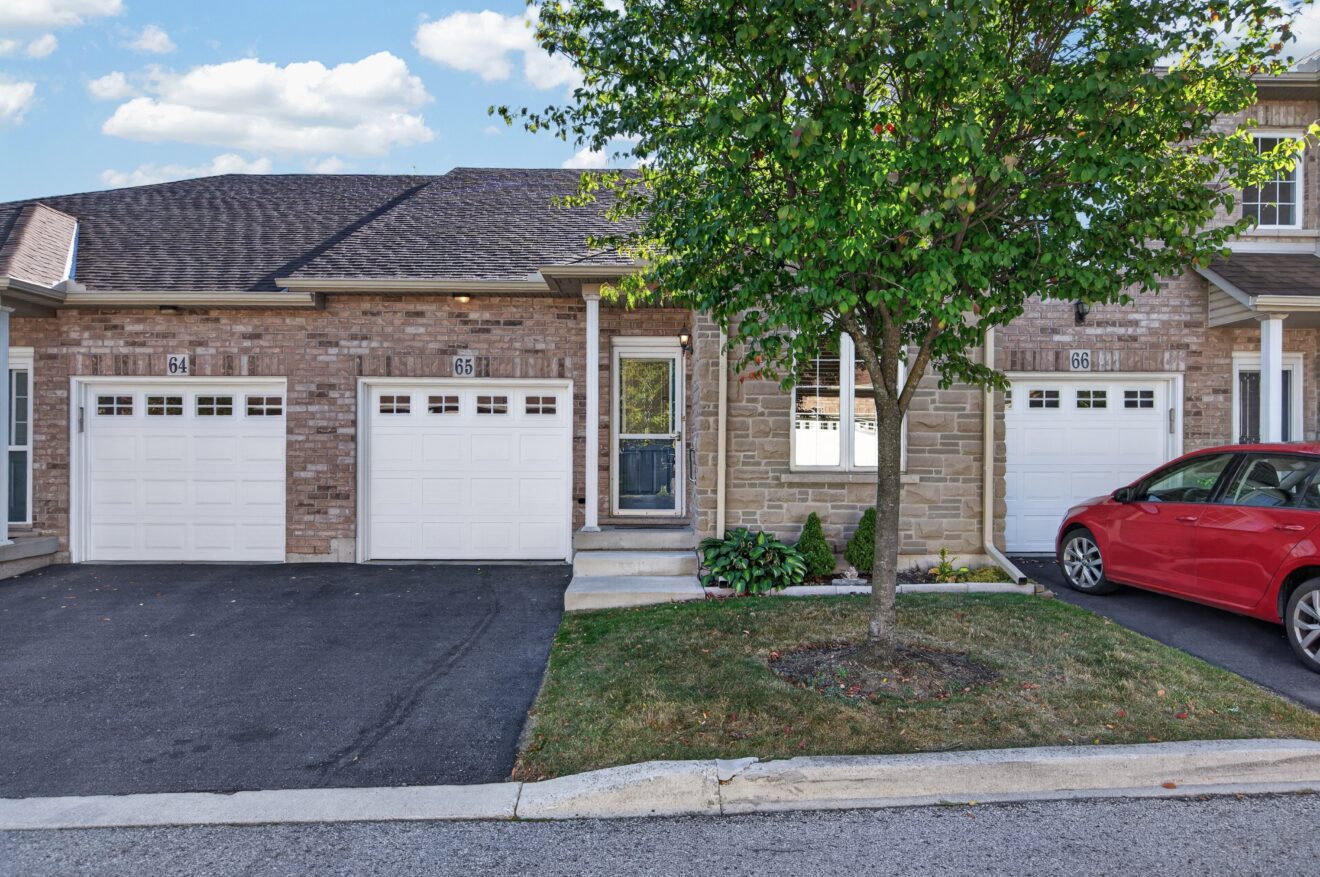
And Unit 65 at 566 Southridge Drive on Hamilton‘s West Mountain provides a useful real-world example.
The Short Answer: What Makes a Bungaloft Appealing to Downsizers?
A bungaloft can bridge the gap between a traditional bungalow and an apartment-style condominium. It can provide the main-floor living many downsizers want while retaining additional bedrooms and flexible living space for guests, hobbies, or family — without requiring the owner to maintain a traditional detached property.
But the right question isn’t simply whether a bungaloft is a good downsizing property.
It’s whether it supports the lifestyle the homeowner wants next.
Downsizing Is Often a Discovery Process
One pattern O’Reilly has noticed working with downsizers is that the search criteria they begin with often changes once they start seeing properties.
That makes sense. Someone who has lived in the same detached family home for 20 or 30 years may have little firsthand experience with today’s bungalow condominiums, bungalofts, townhomes, or apartment condos.
“Sometimes downsizing buyers don’t actually know what they want because they’ve often been in the same home for decades,” O’Reilly says. “It can require viewing several different types of properties before they understand what’s available and start building their ideal wish list.”
In other words, viewing homes isn’t always about finding the home immediately. Early in the process, it can be research.
“Getting out and looking helps refine the overall search criteria,” he says. “Eventually, it starts providing some clear direction for what that next phase of life could look like.”
That may be one of the most overlooked parts of downsizing: you don’t necessarily need to know exactly what you want before you begin exploring.
Related Reading on Our Blog:
What Do Downsizers Actually Need From Their Square Footage?
One of the most common anxieties O’Reilly encounters is the loss of space.
Someone moving from a substantial detached home may assume that downsizing means suddenly feeling cramped.
Unit 65 at 566 Southridge Drive illustrates why that isn’t necessarily the case. The current listing describes the home as a 1,798-square-foot bungaloft with three bedrooms, three full bathrooms, an attached single-car garage, and a full unfinished basement. The primary bedroom and laundry are on the main floor, while the upper level provides a loft, another bedroom, and a bathroom.
“People are sometimes concerned about going from a larger family home into something smaller,” O’Reilly says. “But you’re still dealing with almost 1,800 square feet above grade here, plus a full unfinished basement.”
The more important question is how that square footage functions.
In O’Reilly‘s experience, many downsizers discover that they don’t necessarily need a large finished basement. What they value more is having the spaces they use every day arranged conveniently.
At Unit 65 at 566 Southridge Drive, that means the primary bedroom, ensuite, laundry, kitchen, and principal living areas can all be accessed on the main level. The second floor becomes optional rather than essential everyday space.
The Advantage May Be Flexibility, Not Simply Size
The floor plan also illustrates another useful downsizing principle: a room doesn’t necessarily need one permanent purpose.
The secondary bedroom on the main level could remain a bedroom, become a den, or function as a dedicated office. Upstairs, the loft, bedroom, and bathroom can provide separation when family or out-of-town guests visit.
O’Reilly describes that as one of the property’s most useful attributes:
“You have your everyday living on the main floor, but you’re not giving up the ability to have guests or additional living space,” he says. “The front bedroom can also evolve depending on what you need — a bedroom, office, or den.”
The vaulted living area and upper loft also help differentiate the experience from a conventional one-storey floor plan. For downsizers worried that simplifying will mean sacrificing too much, the better objective may therefore be flexibility without wasted space.
Condo Fees Should Be Evaluated as an Exchange, Not in Isolation
For someone who has owned a freehold home for decades, monthly condominium fees can create immediate resistance.
Unit 65 at 566 Southridge Drive is currently advertised with monthly maintenance fees of $458.99. REALTOR.ca reports that those fees include insurance, common-area maintenance, and parking. Buyers should confirm the corporation’s exact maintenance and repair responsibilities through the condominium documentation rather than assuming every exterior component is covered.
O’Reilly encourages clients to look beyond the number itself:
“When you own a freehold property, you’re responsible for everything,” he says. “Exterior maintenance, landscaping, and major things that eventually need attention — those are your responsibility and your out-of-pocket expenses.”
Condominium ownership changes that relationship.
“Although every condo is different and the fees cover different things, you’re paying toward the ongoing expenses of maintaining the condominium, and a portion also goes toward the reserve fund for major projects,” O’Reilly explains.
For the right homeowner, the calculation therefore isn’t “Do I want another monthly bill?”
A better question is: “What responsibilities, future expenses, and demands on my time am I exchanging for that monthly expense?”
“For many people, they’re ready for that shift,” O’Reilly says. “They don’t want the hassle or headache of maintaining the property anymore. They want to travel, focus on family, focus on hobbies, and put their time and energy into other things.”
Don’t Evaluate a Condominium by Its Fee Alone
A lower condo fee isn’t automatically evidence of a better condominium.
O’Reilly says he wants buyers to understand the corporation behind the property: its rules, financial position, management, and reserve fund.
A resale condominium’s status certificate includes its declaration, by-laws, rules, current budget, audited financial statements, reserve-fund information, common expenses, special assessments, insurance, and litigation information. Reviewing the status certificate with legal counsel is a vital part of our buying services.
Simply seeing a large reserve-fund balance isn’t enough; what matters is whether the fund is appropriately positioned to meet anticipated major repairs and replacements.
For a downsizer seeking greater predictability, that due diligence is an important part of determining whether the promised simplicity of condominium ownership is supported by the corporation’s actual financial condition.
Explore Local Market Trends:
Why This West Hamilton Mountain Location May Appeal to Downsizers
The other half of downsizing is location.
566 Southridge Drive is in Mountview on Hamilton‘s West Mountain. O’Reilly describes the complex as tucked away while remaining convenient to everyday services and transportation.
Harvard Square at 801 Mohawk Road West includes Farm Boy, Shoppers Drug Mart, Pet Valu, and banking services. The property listing also identifies parks, public transit, and other amenities nearby.
For O’Reilly, proximity to neighbouring Ancaster is another part of the appeal.
“You’re very close to Ancaster and the Meadowlands, while still being on the West Hamilton Mountain,” he says. “That’s part of what makes the location interesting.”
When comparing value, however, O’Reilly cautions against comparing a property such as Unit 65 at 566 Southridge Driveindiscriminately with every smaller home in Hamilton. He would begin with sales of similar units within the same condominium and then broaden the analysis to comparable bungalow and bungaloft properties on the West HamiltonMountain and in Ancaster.
That hierarchy matters because housing style, condominium structure, location, size, and functionality can make two seemingly similar “downsizing properties” very different products.
A Bungaloft Isn’t the Right Answer for Every Downsizer
There is also a simple reason someone shouldn’t buy a property like this: they still want a detached home.
“Downsizing doesn’t automatically mean somebody wants condominium living,” O’Reilly says. “Sometimes I’ll work with a buyer who specifically wants to downsize and still wants to be detached. That’s perfectly fine — it just shifts the search criteria and wish list in a different direction.”
That distinction keeps the conversation from becoming overly prescriptive. The objective isn’t to convince every downsizer to choose a bungaloft. It’s to identify which compromises they’re willing to make — and which aren’t actually compromises to them at all.
One Client’s Search Changed the Way She Thought About Downsizing
O’Reilly recalls working several years ago with a recently widowed homeowner who was relocating closer to her daughters in the Hamilton area after selling a rural property elsewhere in Ontario.
Initially, she believed she wanted another detached home. The search lasted several months.
“We looked at a variety of properties, and some of them I felt were simply too large and would require too much exterior maintenance for what she was trying to accomplish,” he recalls.
They even made unsuccessful offers on some detached homes. In retrospect, O’Reilly believes those unsuccessful attempts helped the process.
“Thankfully, some of those deals didn’t come together,” he says.
Eventually, the client purchased a bungaloft in The Bungalows of Ancaster South, a Starward Homes community.
The client remains in the home today, according to O’Reilly:
“She went from thinking she wanted to downsize into another detached property to realizing that turnkey living was actually the right call for her,” he says. “She’s made it her own, and whenever I speak with her, she seems very happy with the decision.”
The lesson isn’t that she should have chosen a bungaloft from the beginning. It’s that the search helped her discover what she actually valued. Read through our client results and testimonials to see how other local buyers and sellers have navigated these big transitions.
Start With the Life, Then Choose the Property
Asked what he would tell someone who knows they’re ready to simplify but doesn’t know where to begin, O’Reilly doesn’t start with bedrooms, square footage, or property type. He starts with questions.
“What does the lifestyle look like? What do they want to spend their time doing? What financial goals do they have? What is it about their current day-to-day lifestyle that they don’t like anymore — and what do they want to keep?”
Those conversations gradually turn an abstract idea like “downsizing” into actual criteria.
“It peels back layers like an onion,” O’Reilly says. “You need a starting point, and from there you can come up with a pretty solid plan, do some preliminary research, and start dipping your toe into the idea of downsizing.”
That’s ultimately the more useful way to think about Unit 65 at 566 Southridge Drive and downsizing generally.
The property isn’t interesting simply because it’s smaller than a large detached family home. It’s interesting because its design represents one possible answer to a much larger question: What kind of home makes the life you want next easier to live?
For some homeowners, the answer will still be a detached bungalow. For others, it may be an apartment condominium.
And for someone who wants main-floor living, room for guests, flexible additional space, and fewer exterior responsibilities, a bungaloft condominium deserves a place in the conversation.
Planning a move or looking to explore your downsizing options across Hamilton, Ancaster, Dundas, or Burlington? Contact Luke O’Reilly and The O’Reilly Group team today to start the conversation.

We're On Your Side
Whether you’re selling or buying the O’Reilly Group is dedicated to elevating your real estate experience.