November 27, 2026 | Buying
Durand vs. Kirkendall: Which West Hamilton Neighbourhood Is Right for You?
Separated by a single street, two of Hamilton’s most desirable neighbourhoods offer distinctly different living experiences. Local Real Estate Broker Luke O’Reilly explains why choosing between them is about considerably more than architecture and price.
There are few places in Hamilton where crossing a single street can so noticeably change the residential experience.
Queen Street South divides two of the city’s most established neighbourhoods. To the east lies Durand, with its remarkable historic estates, mature grounds and quiet residential enclaves. To the west lies Kirkendall, where century homes, covered front porches and the independent businesses of Locke Street South create a distinctive village atmosphere.
Both neighbourhoods offer compelling reasons to live in West Hamilton. But for prospective homebuyers, understanding their differences can be instrumental in finding the right property.
Luke O’Reilly, Founder and Broker of The O’Reilly Group at Royal LePage State Realty, has spent much of his real estate career helping buyers and sellers navigate these communities.
“Although the neighbourhoods are next to one another, there are some major differences between the two,” explains O’Reilly.
Those differences become increasingly apparent when examining the architecture, housing opportunities, privacy and rhythms of everyday life.
Kirkendall: A small town within the city
On a Saturday morning, Locke Street South offers a window into what makes Kirkendall distinctive.
Independent coffee shops, bakeries, restaurants and boutiques create a natural gathering place. The surrounding residential streets allow residents to incorporate these businesses into their everyday routines without necessarily getting into a car.
Unlike commercial districts that operate independently of surrounding residential areas, Locke Street is woven into the fabric of the neighbourhood.
“The Kirkendall neighbourhood generally has more of a small-town feel due to Locke Street Village being located right in the centre and hub of the neighbourhood,” says O’Reilly.
That geographical relationship is an important distinction.
While residents of Durand can also walk to Locke Street, the experience of living a few doors away from the village is different from living a twenty-minute walk away.
For some buyers, that difference is inconsequential. For others, it fundamentally shapes their daily lives.
Kirkendall’s architectural character reinforces this experience. Traditional brick homes, mature trees, covered front porches and relatively compact residential streets create an intimate streetscape that contrasts with some of the larger, more private properties found in southern Durand.
It is an environment where social interaction can develop organically through everyday activities rather than formally organized gatherings.
Related Reading:
- Living in Kirkendall, Hamilton: A Local Guide to Lifestyle, Real Estate, and What Buyers Should Know
Durand: Where Hamilton’s architectural history comes to life
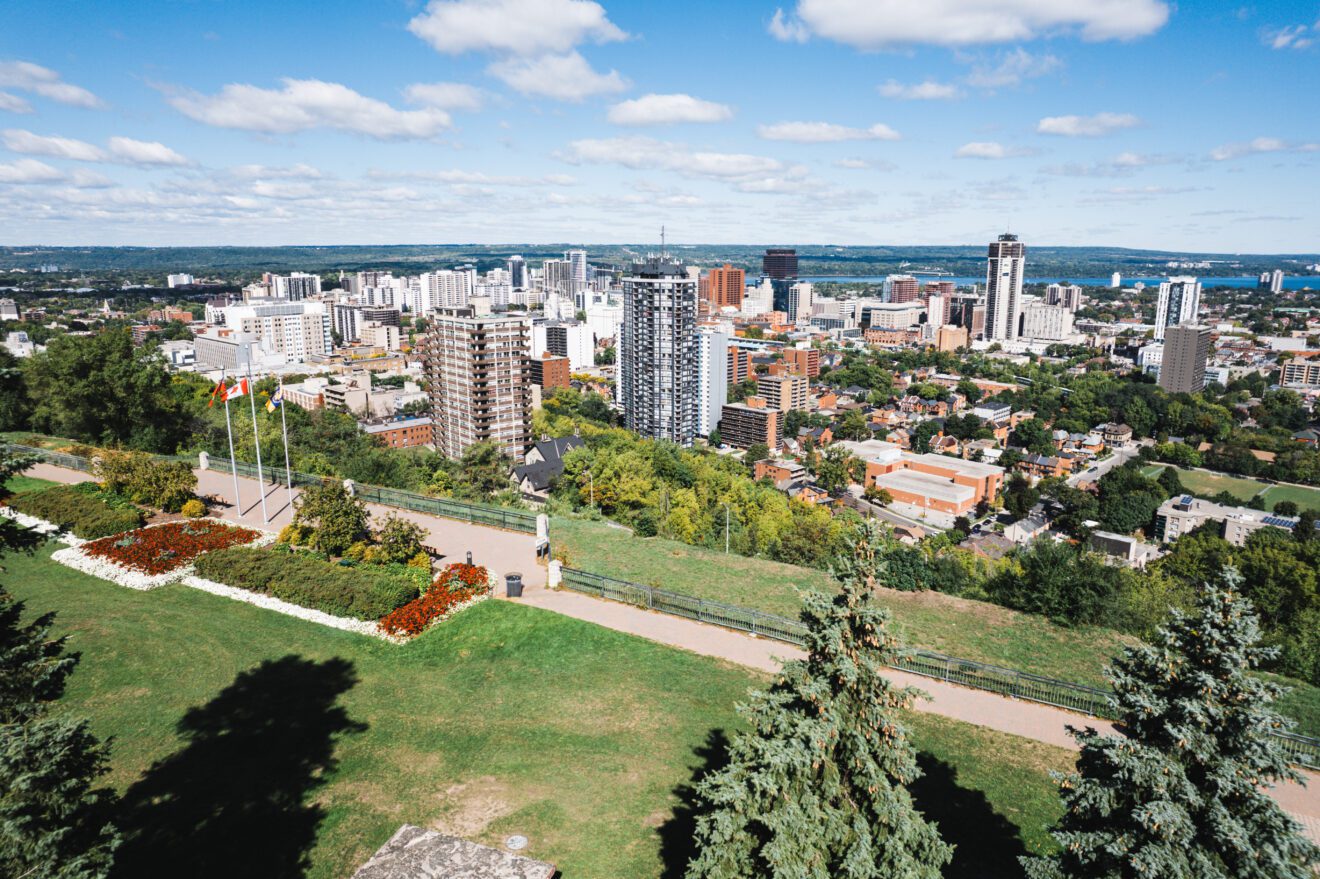
Travel east across Queen Street South and toward the Niagara Escarpment, and a different side of Hamilton begins to emerge.
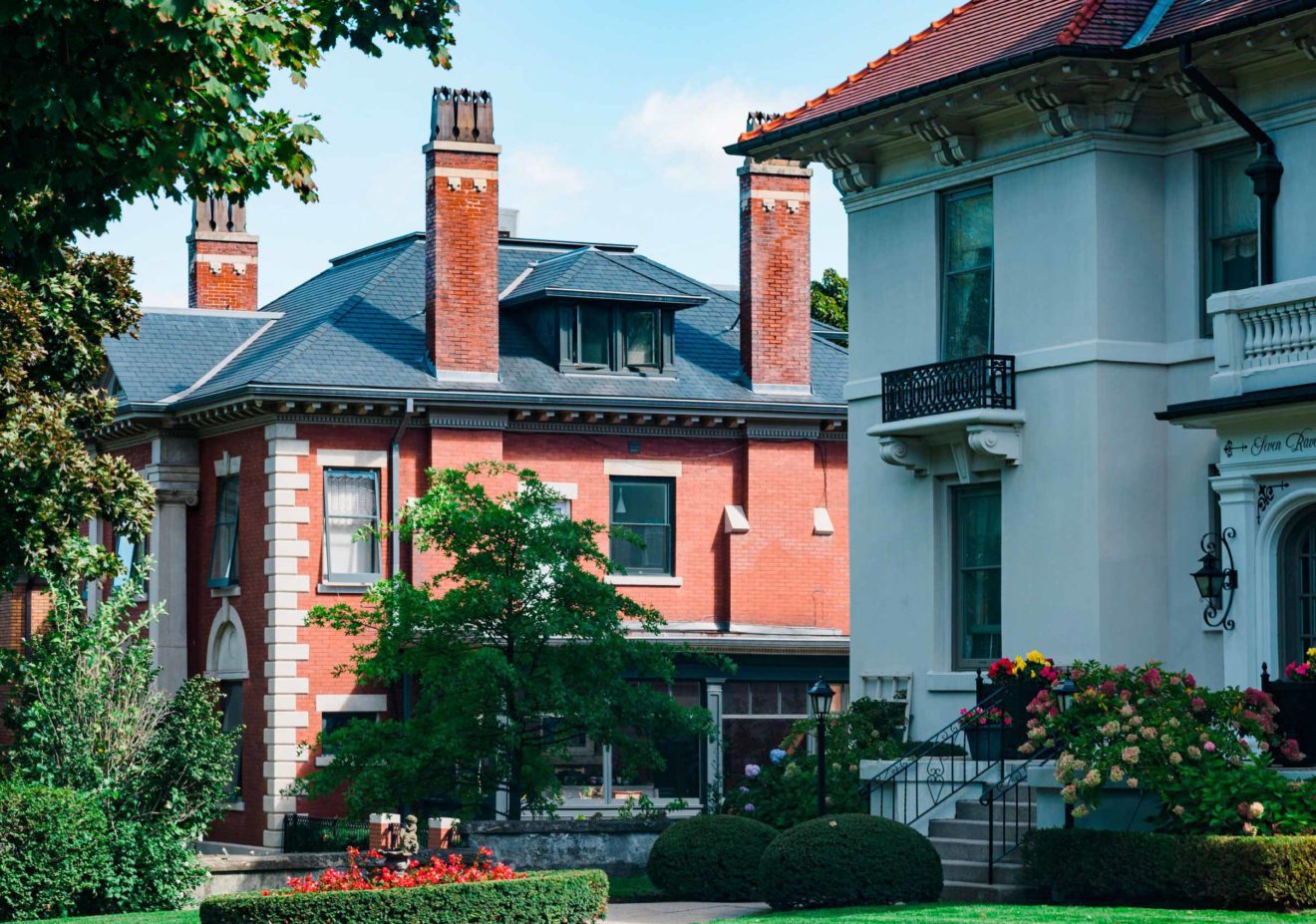
Stately historic residences sit behind mature landscaping. Generous properties provide separation between homes. Original stonework, elaborate architectural detailing and substantial principal rooms reflect an earlier era of residential construction.
Southern Durand contains some of Hamilton’s most distinguished residential architecture.
“In Durand South, there are some of the entire region’s most exclusive real estate and streets, with sprawling estate properties and gorgeous homes,” says O’Reilly.
Streets such as Ravenscliffe Avenue, Turner Avenue, Hess Street South, Inglewood Drive and Undercliffe Avenue offer examples of the architectural distinction associated with this part of the city.
These homes are more than substantial pieces of real estate. They represent a chapter of Hamilton’s history, reflecting the city’s industrial prosperity and architectural ambitions during earlier generations.
For buyers who appreciate original millwork, stained glass, limestone construction, formal entertaining spaces and mature gardens, southern Durand offers opportunities that would be extraordinarily difficult to replicate through contemporary construction.
Related Reading:
- Living in Durand, Hamilton: Historic Homes, Remarkable Architecture and a Neighbourhood Unlike Any Other
- Inside 247 MacNab Street South: A Stately Durand Residence Where Historic Character Meets Exceptional Pride of Ownership
Durand is not one uniform neighbourhood
One of the most important distinctions O’Reilly makes when introducing buyers to Durand is that its residential character changes considerably from north to south.
The closer one travels toward Main Street West and downtown Hamilton, the more urban the environment becomes.
“If you move a little bit further north in the Durand neighbourhood, there’s quite a mix,” O’Reilly explains. “There are single-family residences, there’s lots of multi-family, there are full rental apartment buildings, and there’s also a variety of condo apartment buildings and row homes.”
This architectural and residential diversity has long been part of Durand’s identity.
Historical research examining the neighbourhood’s development between 1946 and 1994 documents the longstanding differences in residential character between northern and southern Durand, demonstrating that the neighbourhood’s internal diversity is not a recent phenomenon.
For prospective buyers, the distinction matters.
Someone purchasing a condominium near downtown Hamilton may have an entirely different residential experience from someone purchasing a historic estate near the escarpment, despite both calling Durand home.
It also means that buyers should not automatically exclude Durand simply because they associate the neighbourhood with multimillion-dollar properties.
Durand vs. Kirkendall: How do home prices compare?
Budget often determines where a buyer’s search begins, but O’Reilly cautions against comparing the neighbourhoods without first considering the type of property being sought.
“If they have a budget over $2 million and they want a quiet, exclusive street and a sprawling property, well, maybe Durand South is right for that particular buyer,” he says.
Southern Durand’s most substantial residences frequently occupy a different segment of Hamilton’s real estate market than the traditional character homes commonly associated with Kirkendall.
Larger lot sizes, architectural significance, privacy and generous living spaces can all contribute to substantial price differences.
Kirkendall, by comparison, can offer buyers an opportunity to purchase a beautifully maintained or extensively renovated character home without necessarily entering the multimillion-dollar estate market.
“I generally find that price points in Kirkendall are a little bit more affordable,” says O’Reilly.
However, he emphasizes that Kirkendall has its own collection of exceptional executive residences.
Hillcrest Avenue, Chedoke Avenue and Amelia Street are among the streets he identifies as offering properties with qualities comparable to those found in southern Durand.
“Those are some of the really impressive streets in the Kirkendall neighbourhood, with some pretty spectacular properties that offer similar qualities to what you’d find in Durand South.”
The challenge is availability.
“Those houses on those streets don’t come up very often.”
For buyers seeking something particularly distinctive, patience may be just as important as purchasing power.
Related Reading:
Schools can influence where buyers focus their search
For households with school-aged children, educational preferences can become an important consideration when comparing Durand and Kirkendall.
Earl Kitchener Elementary School, located on Dundurn Street South, is frequently raised in O’Reilly’s conversations with prospective purchasers exploring Kirkendall.
He notes that the school has developed a favourable reputation among many of the clients he has worked with over the years.
Central Public School, located behind Hamilton City Hall, is another established educational institution serving the surrounding area.
O’Reilly is careful to distinguish client preferences from an objective assessment of educational quality.
“There’s nothing wrong with Central Public School,” he emphasizes. “There’s lots of great families and great kids and great educators that are involved with that school.”
For households considering Catholic education, St. Joseph Catholic Elementary School is located directly on Locke Street South.
Depending on school eligibility and attendance boundaries, this may allow some buyers to expand their property search across both neighbourhoods.
Ultimately, educational decisions are highly personal. Prospective buyers should independently research schools, their programs and current attendance boundaries through the Hamilton-Wentworth District School Board and Hamilton-Wentworth Catholic District School Board before purchasing a property.
Related Reading:
Privacy, community and the changing character of residential streets
There is a temptation to describe Kirkendall as community-oriented and southern Durand as private. While there are physical characteristics that contribute to these impressions, O’Reilly believes the reality is more nuanced.
“Depending on the street that you’re on, some of the streets in Durand can be very private,” he explains.
Larger properties, mature landscaping and greater separation between residences can naturally create a quieter living experience.
Kirkendall’s more compact residential layout and the presence of Locke Street Village provide more visible opportunities for spontaneous interaction.
But neither neighbourhood can be defined entirely by these characteristics.
O’Reilly points to Turner Avenue in southern Durand as an example of how the character of an individual street can evolve over time.
“There’s been quite a bit of turnover on Turner, which is a relatively short street, but over the last five to ten years, a number of young families have moved onto that street.”
Through his relationships with local residents, he has observed friendships developing between neighbouring households.
“A number of the families have become friendly with one another, so that’s really nice to see.”
The example illustrates something that neighbourhood statistics and online descriptions rarely capture: communities are continually evolving.
A street that feels relatively private today may develop a different social dynamic over the next decade. Likewise, residents of quieter streets may have strong connections with their neighbours that are not immediately apparent to an outside observer.
For buyers, this reinforces the importance of evaluating individual streets rather than relying on broad assumptions about entire neighbourhoods.
Walkability: Two neighbourhoods, different destinations
Both Durand and Kirkendall benefit from their established locations within Hamilton’s lower city.
Kirkendall’s most recognizable attraction is Locke Street South, where restaurants, independent retailers, coffee shops and everyday services are concentrated within a relatively small area.
Durand offers convenient access to downtown Hamilton, James Street South, St. Joseph’s Healthcare Hamilton, Hamilton GO Centre and surrounding cultural institutions.
While James Street South provides Durand residents with numerous dining and commercial opportunities, O’Reilly observes that it offers a different experience from Locke Street Village.
“It doesn’t have the same feel that the Locke Street Village has,” he says.
Both communities also benefit from their proximity to the Niagara Escarpment, with access to neighbourhood parks, recreational facilities and nearby trail systems.
For commuters, Kirkendall’s proximity to Highway 403 can be another practical consideration, while Durand’s location may be particularly convenient for those who regularly travel downtown or use GO Transit.
The question is not necessarily which neighbourhood is more walkable. It is which neighbourhood puts the places you regularly visit within the most convenient reach.
Why buying the right home requires patience
Despite their popularity, neither Durand nor Kirkendall offers an unlimited supply of available real estate.
This is particularly true when buyers have specific requirements related to architecture, lot size, parking, property condition or location within a particular residential pocket.
O’Reilly says that buyers rarely need to make a definitive decision between the two neighbourhoods before beginning their search.
Instead, their preferences tend to become clearer as they experience different properties firsthand.
“Usually it’s an ongoing process where I’m working with a buyer, and by process of elimination and exposing them to certain properties, they can continue to refine their search and decide whether or not something’s right for them.”
That process can reveal priorities buyers did not initially recognize.
A purchaser who originally wanted a substantial historic residence might discover that they place greater value on proximity to Locke Street. Another might realize that the privacy and architectural character of southern Durand are worth compromising on other aspects of their search.
O’Reilly believes that a REALTOR® has a responsibility to help buyers understand not only the appeal of a particular property, but also its potential drawbacks.
“My job when I’m working with clients as well is to point out any areas of concern so that they truly have a full understanding of what the likely experience will be like living in the home in the future.”
That approach is particularly relevant in neighbourhoods where century homes make up a meaningful portion of the housing stock.
Original foundations, older mechanical systems, heritage considerations, parking limitations and previous renovations all deserve careful examination before a purchase.
Related Reading:
Durand vs. Kirkendall at a glance
| Consideration | Durand | Kirkendall |
| Residential character | Historic estates and diverse urban housing | Traditional character homes and village-oriented living |
| Commercial amenities | James Street South and downtown Hamilton | Locke Street Village and Dundurn Street |
| Architecture | Substantial historic residences, century homes and apartments | Brick century homes, traditional residences and select executive estates |
| Luxury properties | Concentrated primarily in southern Durand | Select streets, including Hillcrest, Chedoke, Amelia amongst others |
| Privacy | Greater physical separation on certain southern streets | Generally more compact residential streets |
| Transportation | Convenient access to downtown and Hamilton GO Centre | Convenient access to Highway 403 |
| Housing affordability | Broad range depending on property type and location | Generally more accessible than southern Durand’s estate market |
| Outdoor recreation | Durand Park and escarpment proximity | HAAA Grounds (newly renovated), Chedoke area and nearby trail access |
Which West Hamilton neighbourhood is right for you?
The appeal of Durand and Kirkendall ultimately comes down to two different interpretations of urban living.
Durand offers extraordinary architecture, historical significance and the opportunity to purchase some of Hamilton’s most remarkable residential properties. Its diverse housing stock also provides opportunities beyond the luxury market.
Kirkendall offers the appeal of an established residential community built around a thriving commercial village, with character homes and everyday amenities within walking distance.
Both offer qualities that are increasingly difficult to reproduce in newer residential developments.
For O’Reilly, the best approach is to allow buyers to experience the neighbourhoods, refine their priorities and make an informed decision based on the properties that become available.
“Typically, when we do go through ‘the one,’ the house that they decide to offer on and purchase, they usually know,” he says.
“They’ve worked through their criteria, they understand the neighbourhoods, [and] they really have a solid idea of what they want.”
Perhaps that is the most meaningful distinction between simply purchasing a property and finding a place to call home.
The decision is not always about which side of Queen Street South you live on. It is about finding the home, the street and the surroundings that complement the life you want to lead.
Related Reading:
Frequently asked questions about Durand and Kirkendall
Is Durand more expensive than Kirkendall?
Southern Durand generally occupies a higher price segment for substantial historic and executive residences, some of which exceed $2 million. Kirkendall typically offers more accessible character-home opportunities, although exceptional properties in both neighbourhoods can command premium prices.
What street separates Durand and Kirkendall?
Queen Street South generally separates the two neighbourhoods, with Durand to the east and Kirkendall to the west.
What are some of Durand’s most notable residential streets?
Aberdeen Avenue, Bay Street South, Ravenscliffe Avenue, Turner Avenue, Hess Street South, Inglewood Drive, Chilton Place and Undercliffe Avenue are among the streets recognized for their distinctive architecture and substantial historic residences.
What are some of Kirkendall’s most notable residential streets?
Hillcrest Avenue, Chedoke Avenue and Amelia Street offer some of Kirkendall’s most distinctive executive residential properties. The neighbourhood also contains numerous established residential streets surrounding Locke Street South.
Can you buy a home in Durand without a luxury real estate budget?
Yes. Northern and central Durand offer a broader range of residential properties, including condominiums, row homes and smaller detached residences. Purchasing opportunities depend on current inventory and individual property requirements.
Are Durand and Kirkendall good neighbourhoods for walking?
Both offer convenient pedestrian access to a variety of amenities. Kirkendall is particularly associated with the Locke Street Village, while Durand provides convenient access to downtown Hamilton, James Street South and Hamilton GO Centre.
Considering a move to Durand or Kirkendall?
Whether you’re relocating to Hamilton, searching for a historic residence or considering selling your existing home, understanding the nuances of individual neighbourhoods can make a meaningful difference.
The O’Reilly Group provides personalized real estate guidance throughout Hamilton, Ancaster, Dundas and Burlington, combining firsthand neighbourhood knowledge with property-specific analysis and extensive transaction experience.
Luke O’Reilly is the Founder and Broker of The O’Reilly Group at Royal LePage State Realty. Licensed since 2010, The O’Reilly Group are members of Royal LePage’s National Chairman’s Club Award, recognizing them as one of Canada’s top producing real estate teams, among the top 1% nationally for 2025 production.

We're On Your Side
Whether you’re selling or buying the O’Reilly Group is dedicated to elevating your real estate experience.